
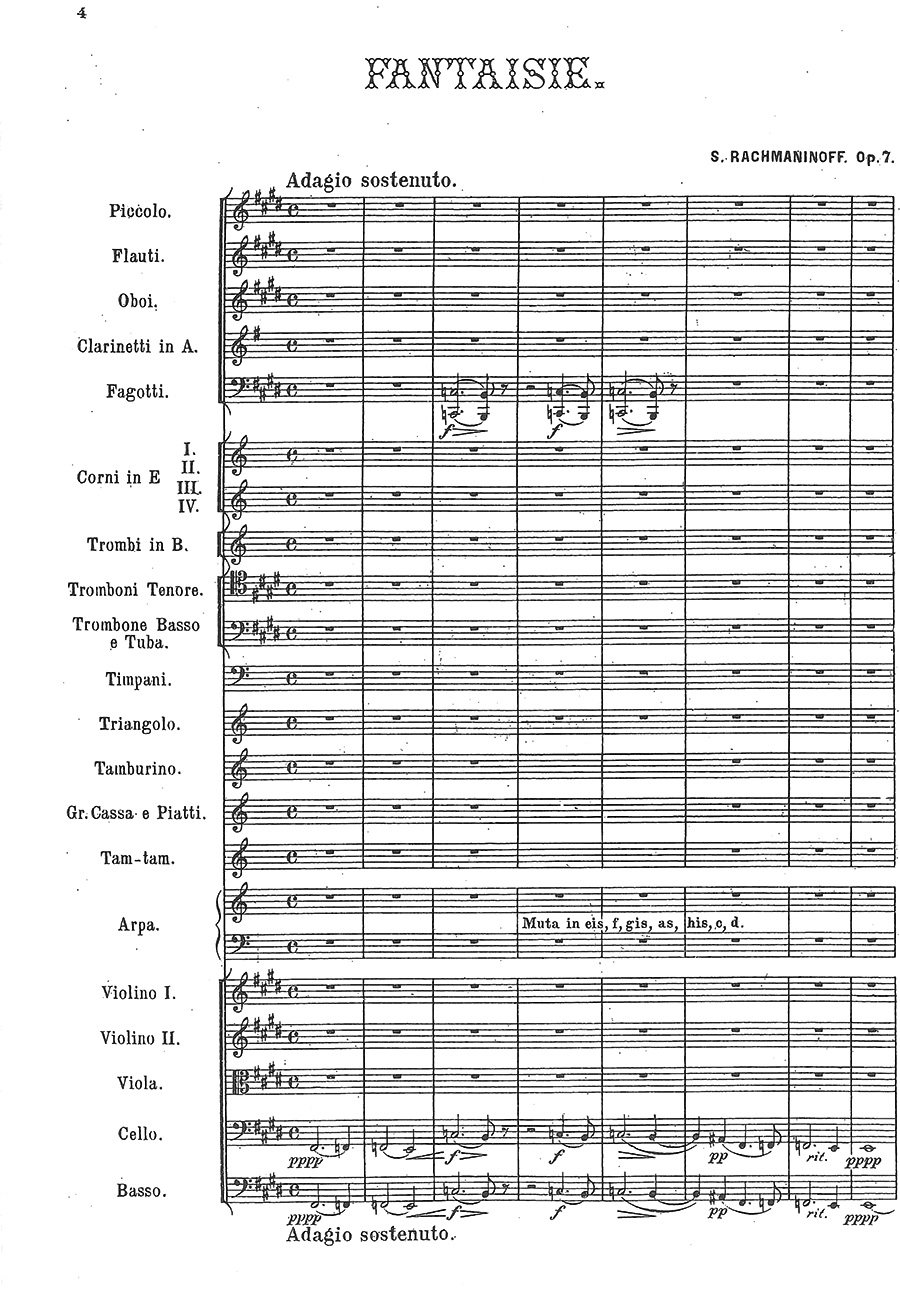
The Rock, Fantasy Op. 7 for orchestra
Rachmaninoff, Sergey
19,00 €
Sergei Vasilyevich Rachmaninoff (Сергей Васильевич Рахманинов) – The Rock, Fantasy, op. 7
(b. Oneg, Novgorod, Russia 2 April [O.S. 6 March] 1844 – d. Beverly Hills, California, USA 28 March 1943,)
Fantasy, op. 7 / фантазия [Utyos: fantasiya]
Composed
Summer 1893; in 1894, P. Jurgenson (Moscow) published both the full score and the composer’s own reduction for piano, four hands
First performance
2 April [O.S. 20 March] 1894 in a concert of the Russian Musical Society, Moscow conducted by Vasily Sanfonov
Preface
Sergei Rachmaninoff’s formative years were difficult, for despite his obvious musical talents, his adolescence was blight- ed by the death of his sister from diphtheria, his father’s squandering of the family fortune, and the ultimate separation of his parents. After failing most of his exams at the St. Petersburg Conservatory in 1885, his mother arranged for him to live and study with Nikolai Zverev (1832-1893), who had a reputation as both a teacher at the Moscow Conservatory and a disciplinarian.
For the next four years, Rachmaninoff lived with fellow-student Mikhail Pressman at Zverev’s and honed his skills as a pianist (practicing most days from 6-9am). Zverev took him to concerts and invited him to entertain at his din- ner parties for Anton and Nicholas Rubinstein and the Tchaikovsky brothers (Peter and Modest). After his first year in Moscow, Rachmaninoff was ready to begin Anton Arensky’s harmony classes at the Moscow Conservatory, and tran- scribed Tchaikovsky’s Manfred symphony for piano, four hands (1886, now lost). Zverev arranged for both thirteen-year- olds to play the work for Tchaikovsky, and then included both in a fully memorized concert version of Beethoven’s Symphony No. 5 (for piano, eight hands) presented to Sergei Taneyev (1856-1915), the director of the Conservatory.
Rachmaninoff student works include a delicate Scherzo in D Minor, three Nocturnes for piano, an unfinished opera Esmerel- da (based on Victor Hugo’s Notre Dame de Paris), two works for string quartet, and his first songs. While taking courses taught by his cousin, Alexander Siloti, Rachmaninoff added Taneyev’s composition class and befriended Alexander Scri- abin (1872-1915). After a heated argument with Zverev in 1889 (Rachmaninoff had requested his own piano and some pri- vacy to compose), he lodged with his classmate (the singer Mikhail Slonov) and his Aunt Varvara Satina (his father’s sister).
During his last year at the Conservatory, Ramaninoff received his first commission, from Tchaikovsky’s publisher Jurgen- son, for a piano-duet transcription of Tchaikovsky’s Sleeping Beauty and made his conducting debut with the Conservatory Chorus. Although he really had two years of study left, he received permission to take his piano exams a whole year early (since his cousin and teacher Siloti had resigned), and graduated in 1891 with honors in piano. The extra time required for memorization of works by Chopin and Beethoven caused Rachmaninoff to postpone the Sleeping Beauty transcription, and Siloti had to make dozens of corrections to appease Tchaikovsky. Arensky also agreed to allow him to take him final theory/composition exams a year early (in 1892), so Rachmaninoff had to quickly complete a symphony movement, some songs, and an opera. On March 17, Rachmaninoff premiered the first movement of his Piano Concerto, and on April 15, his opera was due (the students were only notified of the subject they had to use on March 15). It was a particularly chal- lenging spring, as Rachmaninoff’s father showed up in Moscow, requested financial support, and moved in with his son.
The opera subject turned out to be Aleko, adapted from Pushkin’s 1824 poem Цыгане [Tsïgane/The Gypsies]. Rach- maninoff dashed off the work in fifteen days, winning the Great Gold Medal (only the third time it had ever been awarded), and receiving a publishing offer from Karl Gutheil. Zverov, who was on the judging committee, even followed the nineteen-year-old composer out of the examination room and gave him his own gold watch. After consulting with Tchaikovsky, Rachmaninoff accepted 500 roubles for Aleko and Two Pieces for solo cello and piano (more than thirty times his monthly earnings from his single piano pupil) – Gutheil remained his publisher until 1914, when the firm was taken over by Koussevitsky. …
Read preface / Vorwort > HERE
| Score Number | 1619 |
|---|---|
| Edition | Repertoire Explorer |
| Genre | Orchestra |
| Pages | 78 |
| Size | 210 x 297 mm |
| Printing | Reprint |
